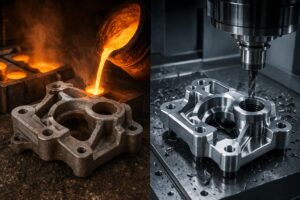




When the Details You Cannot See Make the Difference
Precision Is Not Just About the Machine
When micron-level tolerances are required, it is often assumed that technology alone determines the result. In practice, however, the machine itself — even when using top-tier equipment from companies such as Sodick, Makino, or Hermle— is only one part of the entire system.
True precision is achieved through the combination of several factors:
- ambient temperature
- workpiece temperature
- clamping method
- process stability throughout the entire operation
These factors play a crucial role in both manufacturing and tool repair processes.
Temperature: The Greatest “Invisible Enemy” of Precision
When working within micron-level tolerances, thermal stability becomes critical.
Materials react to temperature changes through thermal expansion, and even the smallest deviation can significantly affect the final result. With tolerances measured in microns, even minimal dimensional changes become highly important.
In practice, this means:
- the workpiece may change dimensions during machining
- after heat treatment, the part must be properly stabilized
- the machine itself must also reach thermal stability
That is why we continuously monitor:
- ambient temperature
- workpiece temperature
- process media temperature (e.g., dielectric fluid in EDM machining)
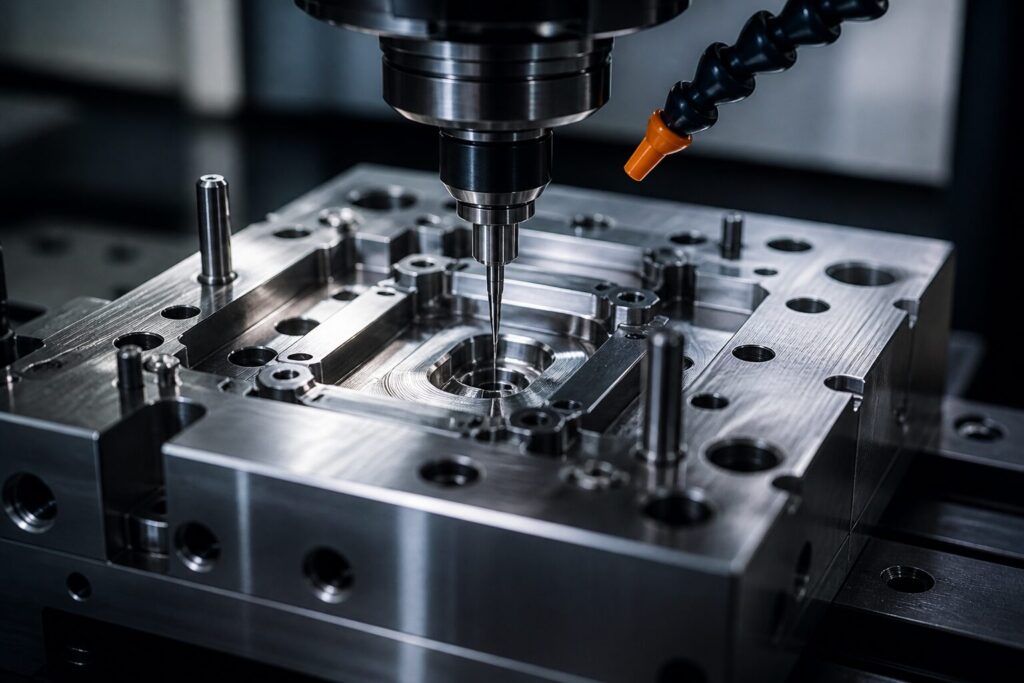
Workpiece Clamping: Microns Begin in Mechanics
Achieving micron-level tolerances requires precise clamping regardless of the technology used — whether EDM or CNC machining.
- improper clamping can cause microscopic deformations
- internal material stresses may be released during machining
- insufficient stability leads to dimensional deviations
In repair operations, the situation becomes even more sensitive:
- the part already has a mechanical and thermal history
- deformations are often hidden
Therefore, the following are essential:
- precise referencing
- symmetrical and stable clamping
- stress minimization
EDM Technology: Process Control at the Micron Level
Although electrical discharge machining (EDM) does not generate cutting forces, the process is extremely sensitive to stability.
To achieve micron-level tolerances, we utilize Sodick technology characterized by:
- backlash-free linear drives
- precise spark gap control
- high-resolution positioning
However, the machine itself is not the only factor — the way the process is managed is equally important:
- multiple finishing passes
- machining with minimal discharge energy
- stability of discharges and environmental conditions
CNC Machining: Precision Within the Cutting Process
In CNC machining, precision depends on the combination of machine capability, tooling, and machining strategy.
We primarily use technologies from Makino and Hermle, which provide:
- high rigidity and stability
- micron-level positioning accuracy
- process repeatability
To achieve micron-level tolerances, the following are essential:
- correct cutting parameter selection
- vibration minimization
- optimized tool paths
- thermal load control during machining
The Details That Make the Difference
At micron-level tolerances, even “invisible” factors become decisive:
- workpiece stabilization time
- handling methods (even the heat from human hands can influence the result)
- cleanliness and stability of process media
- proper sequencing of operations

Manufacturing vs. Repair
From a precision standpoint, repairs are often more demanding than manufacturing a completely new part.
The reasons include:
- existing wear
- unknown internal stresses
- the need to match the original geometry
In such cases, the combination of experience and technology becomes critical.
Conclusion
Achieving micron-level tolerances in both EDM and CNC machining is not the result of a single factor, but of a comprehensive approach.
At our company, we focus on:
- controlling all input conditions
- precise process setup
- utilizing advanced technologies such as Sodick, Makino, and Hermle
- many years of experience in precision engineering
It is precisely the combination of technology, know-how, and attention to detail that allows us to consistently achieve micron-level precision — whether in the manufacturing of new components or in tool repair applications.