




When to Cast and When to Machine? A Practical Technical and Economic Comparison
When decisions are made at the beginning, the results show up at the end
Casting vs. machining—the choice between casting and subtractive machining is one of the decisions that fundamentally impacts the entire project, from manufacturing costs to the real-world functionality of the part.
In practice, this is not a simple comparison of two technologies. It’s a decision that must take into account:
- required precision
- mechanical load
- part geometry
- production volume
- total lifecycle cost
Underestimating any of these factors is often the reason why a “cheaper solution” ultimately becomes more expensive.
Casting: Efficient shaping, limited precision
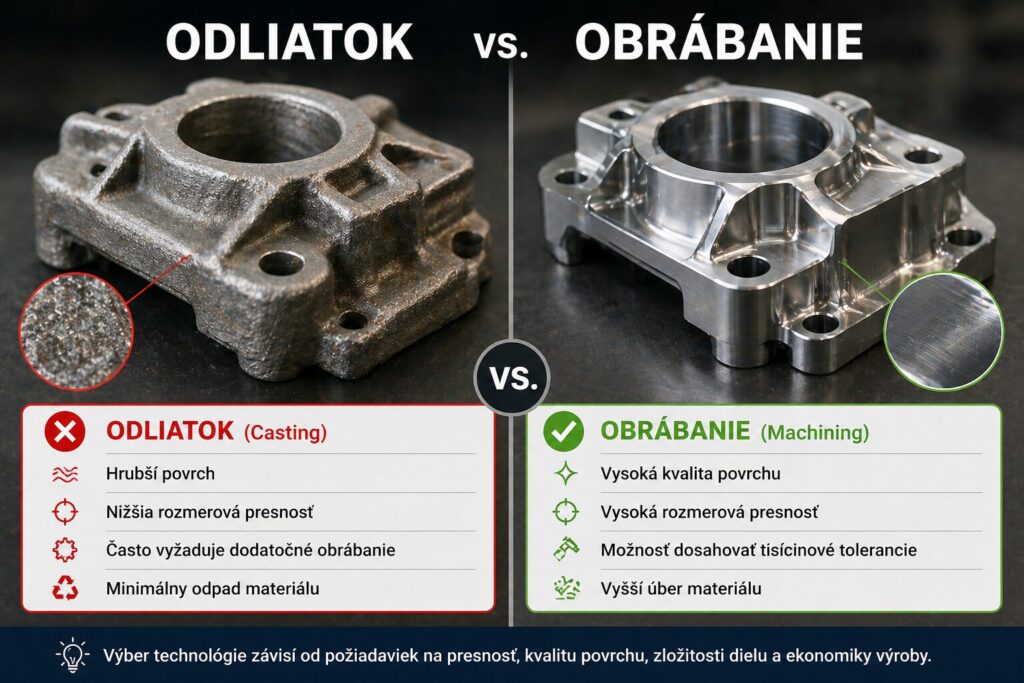
Casting is a technologically efficient way to produce geometrically complex parts. It enables shapes that would be time-consuming and costly to achieve through machining.
Typical advantages:
- near-net-shape production
- integration of complex geometries and internal cavities
- low unit cost at higher volumes
However, there are inherent limitations:
- typical tolerances range from ±0.1 mm to ±0.5 mm (depending on the process)
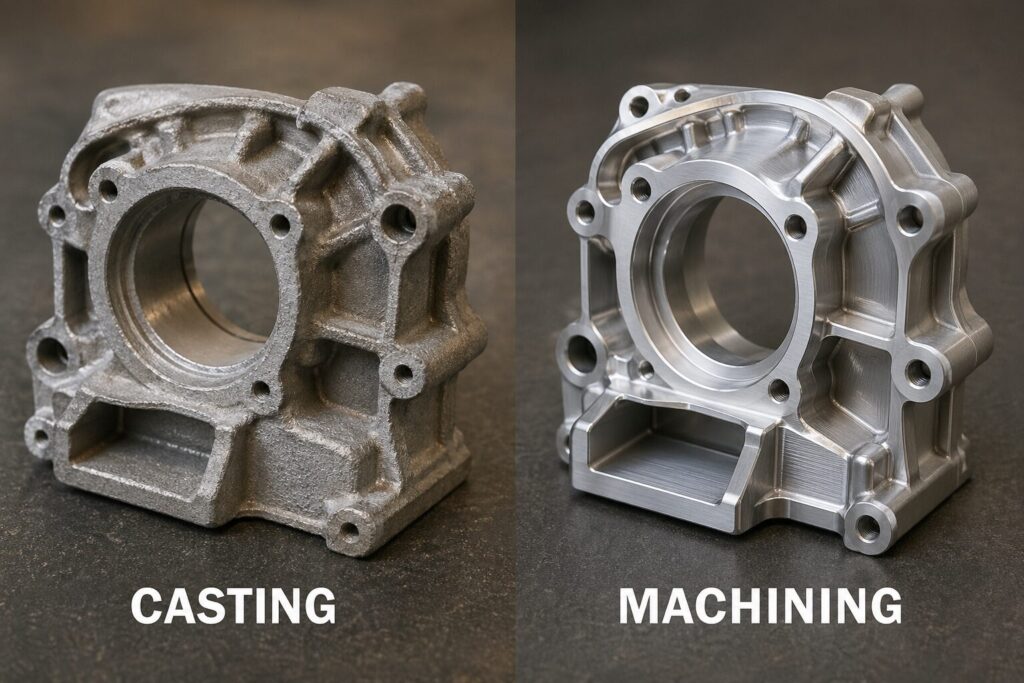
- surface quality often requires secondary machining
- internal defects (porosity, shrinkage) may affect functionality
- higher material variability compared to machined stock
For this reason, castings are usually not final parts, but rather a technological base for further operations.
Machining: Precision that defines function
Machining comes into play where real-world functionality is critical.
In practice, this includes:
- sealing surfaces
- functional mating surfaces
- precision fits and tolerances
- critical edges and contours
These features determine whether a part will function reliably, seal properly, and withstand long-term loads.
On modern machining centers, extremely fine surface finishes and high-quality precision can be achieved—essential for functional surfaces.
Machining capabilities:
- standard accuracy: approximately ±0.01 mm
- high-precision operations: even tighter tolerances depending on the application
At this level, casting alone is not sufficient.
Final operations may also involve specialized processes such as EDM (Electrical Discharge Machining), which allows material removal without mechanical stress—critical for delicate or thin-walled components.
Disadvantages of machining:
- higher material waste
- longer production times for complex geometries
- increasing costs for large production volumes
Mechanical properties: The invisible difference
For dynamically loaded parts, not only shape but also internal material structure is crucial.
Cast parts:
- may contain micro-defects
- exhibit non-homogeneous microstructure
- lower fatigue resistance
Machined parts (from rolled or forged stock):
- homogeneous structure
- higher reliability
- better performance under cyclic loading
This is why critical components are primarily produced through machining.
Economic comparison: Where the decision is made
1. Initial costs
Casting:
- high tooling costs (thousands to tens of thousands of €)
- economical only at higher volumes
Machining:
- minimal upfront costs
- ideal for prototypes and small batches
2. Unit costs
Casting:
- low at large volumes
- significantly higher at small batch sizes
Machining:
- stable but higher per part
- dependent on machining time
3. Hidden costs
This is where the biggest differences arise:
- secondary machining of castings
- scrap rates
- repairs and adjustments
- part lifetime in operation
When to choose casting vs. machining
Casting is suitable if:
- production volume is high
- the part has complex geometry
- precision is not critical
Machining is necessary if:
- high precision is required (±0.05 mm or tighter)
- functional surfaces are involved
- the part is mechanically stressed
Combination is optimal if:
- both complex geometry and precision are required
- a balance between cost and function is needed
Conclusion
The choice between casting and machining is not a matter of preference, but of proper technical analysis.
Casting defines the shape.
Machining defines the precision.
And in the end, it is precision that determines whether a part will function reliably—or generate additional costs.